
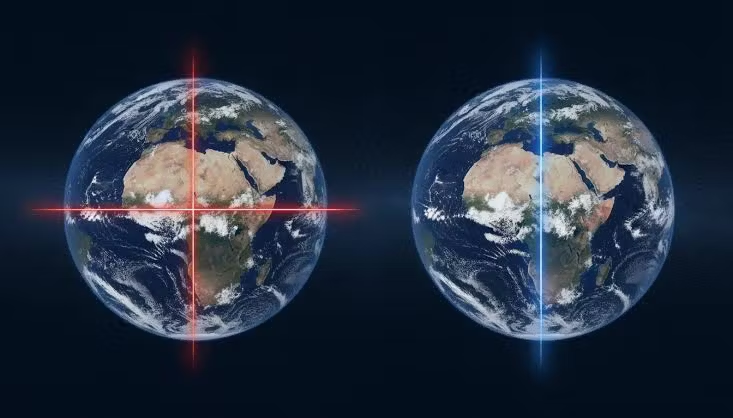
The data were there, accumulated over 25 years in the satellites of NASA’s CERES project. And yet, no one had noticed what they revealed until Jianhao Zhang and his NOAA team analyzed them with a different approach: Earth has a second hidden dividing line, an invisible geometric axis that runs along the 27° East and 153° West meridians, splitting the planet into two east-west hemispheres with an almost perfect energy balance.
That axis crosses Europe, Turkey, Africa, and Alaska. On each side, the amount of sunlight absorbed and reflected is practically identical. The phenomenon, which the researchers call ‘triple symmetry,’ involves three factors that align in an astonishing way: the land surface, the radiative effect of clouds, and the extent of ice-free ocean in both halves. The study was published in the journal Nature, and the authors themselves admitted they did not understand how no one had detected this symmetry before.
What makes the finding even more unsettling is what it implies going forward: current climate models do not fully reproduce this symmetry, which means there is something fundamental in the planet’s energy behavior that we still are not calculating correctly. If this invisible line influences the Walker circulation and the El Niño phenomenon, as the study suggests, understanding it could change the way we predict the global climate. 🌍