
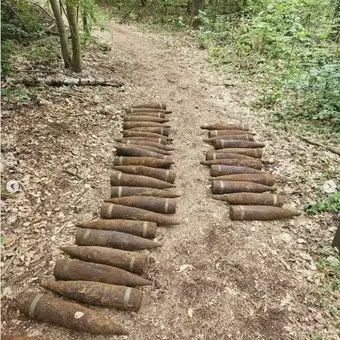
A resident of Berlin’s Pankow district went for a walk in the forest on an ordinary day in May 2026. What he found among the trees brought the police to a halt, closed off access to the area, and forced the deployment of special explosives units: 59 Soviet 122 mm artillery shells, completely intact, that had spent more than eight decades waiting silently beneath the ground of a city of nearly four million inhabitants.
The total weight of the ammunition exceeded one and a half tons. The shells, manufactured during World War II, were removed one by one by Berlin’s State Criminal Police Office — the LKA — following strict safety protocols. Berlin Police shared the discovery on their social media along with photographs showing the shells stacked with an almost unsettling normality.
What is most unsettling is not the discovery itself, but that it is not an exception. In Germany, finding unexploded World War II ammunition remains a recurring phenomenon more than 80 years after the end of the conflict. Berlin, the epicenter of the final battles of that war, still holds in its subsoil an incalculable quantity of the remains of the weaponry that destroyed it.