
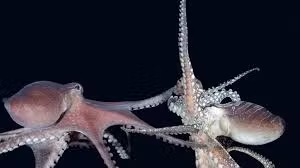
Imagine that your partner could eat you alive if you get too close. Male octopuses have known this for millions of years, and their solution is as ingenious as it is disturbing. 🐙
A study from Harvard University, published in the journal Science, describes in detail what the California two-spot octopus (Octopus bimaculoides) does to reproduce: it uses a specialized arm called a hectocotylus that detects the female through chemical signals, locates her oviduct in total darkness, and fertilizes her without needing to see or touch her. The trick works because that arm has receptors called CRT1 that react to the progesterone released by the female. No visual contact. No getting close. No risk of ending up as dinner.
Researcher Nicholas Bellono, who led the study, describes it bluntly: the arm acts like a tongue that analyzes the chemical environment. The experiments were carried out with opaque barriers and in total darkness, and the arm still found its destination. The funniest part of all: this adaptation does not exist in any other known species. Octopuses have been practicing healthy distancing for millions of years, and only now are humans beginning to understand it. 🐙