
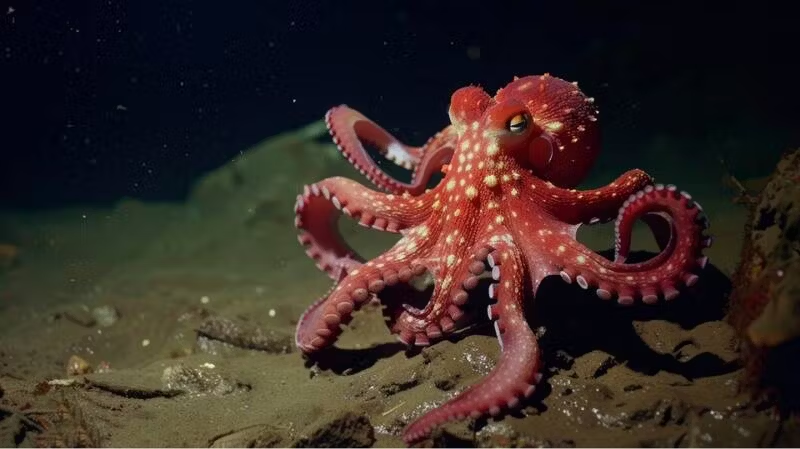
Tim Coulson, a zoologist at the University of Oxford, published an analysis that is already circulating in academic circles: if Homo sapiens disappeared tomorrow, octopuses would be the strongest candidate to occupy the cognitive niche we would leave empty. He does not say it as a metaphor. He backs it up with concrete biology: octopuses possess a nervous system with 500 million neurons, two thirds distributed in their tentacles, which allows them to process information in a decentralized way, without depending on a central brain. They use tools, solve mazes, communicate through complex chromatic patterns, and demonstrate long-term memory. Coulson argues that, given enough time — millions of years of evolutionary pressure without human competition — those abilities could scale toward forms of social organization and, eventually, toward civilizations with underwater architecture. Primates, dolphins, and corvids also appear on his list, but none combines physical dexterity and distributed cognition with the same density as cephalopods. Evolution, Coulson clarifies, does not follow scripts: it is the ecological vacuum that decides who fills the space.