
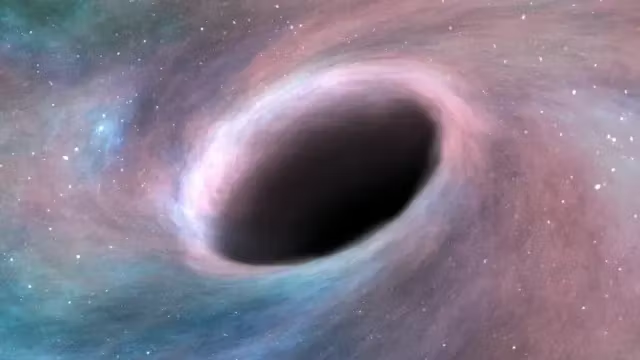
For decades, supermassive black holes filled the role of the cosmos’s villains: gravitational monsters that swallow gas, dust, and anything that gets too close. A new study led by Barry McKernan, an astrophysicist at the City University of New York, proposes exactly the opposite.
According to the model published in the arXiv repository, the dust tori surrounding active galactic nuclei — the outer regions, where temperatures drop considerably — function as planetary nurseries. In those zones, massive planets would form, including worlds the size of Jupiter or larger. The study’s most radical conclusion: those environments would host the largest population of planets in the entire known universe.
Until now, no one had considered the surroundings of an active black hole as a candidate for world formation. The study has not yet undergone peer review, so its conclusions are hypotheses based on models, not confirmed observations. But if the model withstands scientific scrutiny, the object we have always imagined as the end of everything would turn out to be, in fact, one of the cosmos’s greatest creators of worlds.