
Martin Bryant was 28 years old and had his body covered in burns when psychiatrist Paul E. Mullen went in to see him, just 48 hours after the Port Arthur massacre in Tasmania, on 28 April 1996.
Bryant looked at him and asked with a smile: “Did you know I hold the record now?”.
There was no crying or justification. Bryant only seemed interested in the notoriety he had achieved after murdering 35 people, including children; before acting, he had studied other lone shooters with the sole aim of surpassing them in the number of victims. The psychiatrist would go on to describe him as a man deeply concerned with his own importance and the attention he received.
But perhaps the most baffling thing was the contradiction that had accompanied Martin for virtually his entire life.
He was blond, blue-eyed, and physically attractive. At first glance, he could also seem intelligent. The problem was that from an early age he failed to meet any of the expectations his appearance created. Those who began talking to him quickly discovered his enormous limitations in understanding situations, relating to others, and maintaining a more complex conversation.
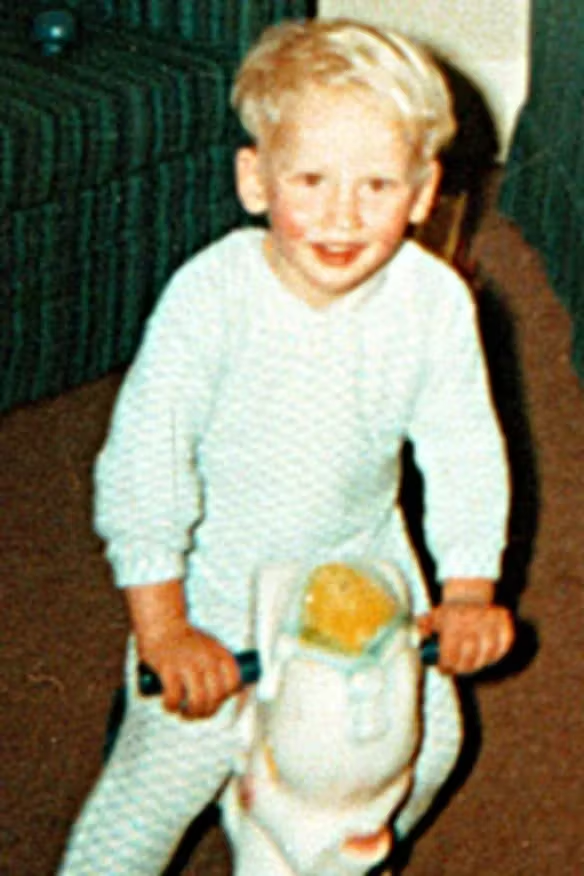
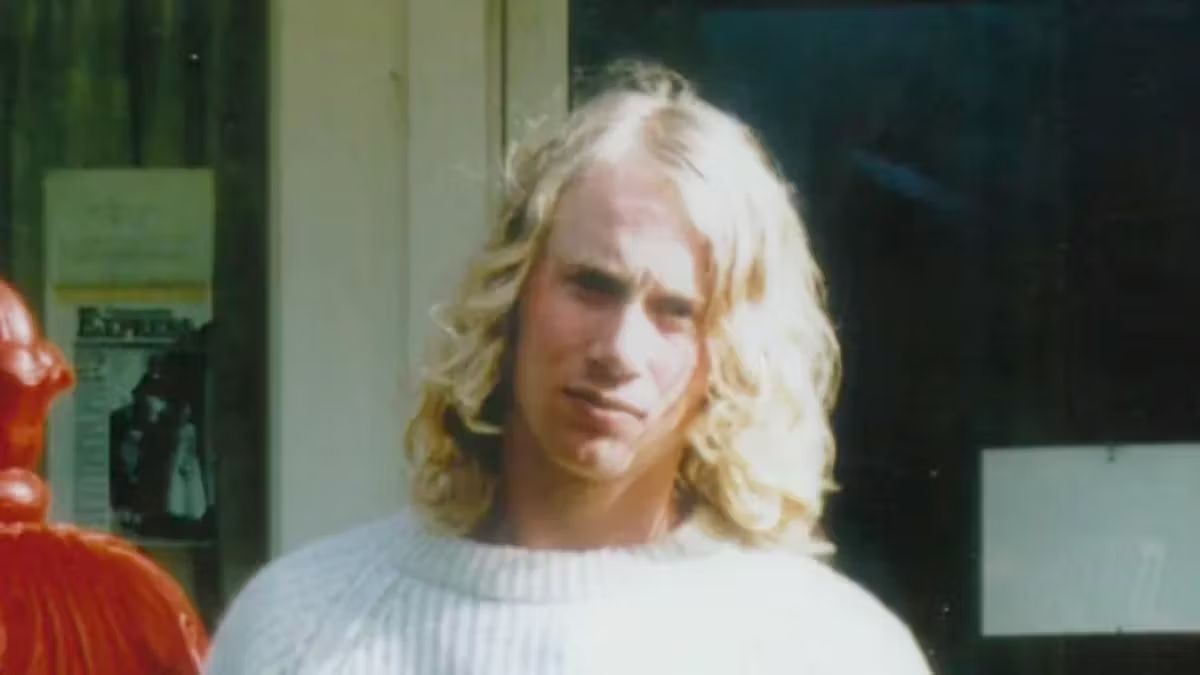
Tests conducted before and after the massacre placed his IQ at 66, within the lowest 1 or 2 % of the population. Mullen himself considered that his appearance may have worsened his social difficulties.
At school, he had serious academic and socialization difficulties. His classmates mocked him, and he eventually became known derisively as “Stupid Martin”. He also began displaying problematic and violent behavior, was suspended from primary school, and eventually transferred to special education.
When he finally left school for good, his prospects were no more encouraging. An assessment conducted to determine whether he could receive a disability pension indicated that he could barely read or write and warned that he would probably have enormous difficulty managing without his parents’ help.
Martin seemed lost, but then Helen Harvey appeared.
The heiress to a fortune met Bryant while he was working as a gardener. She also led a solitary life, and an unconventional romantic relationship developed between them.
Bryant moved in with her and, for the first time, gained access to a life that until then had seemed completely beyond his reach.
Things took a strange turn in 1992, when she died in a car accident. Everything suggested that it had not been an accident, and Bryant was the main suspect, but he could not be charged for lack of evidence and ended up inheriting a substantial amount of money.
He thought that at last money would bring him friends, and although many people approached him, it was always to gain some benefit or take advantage of him. He remained practically alone.
Martin Bryant entered the Broad Arrow Café like any other tourist. He ordered food. He went back inside, pulled out a rifle, and in 90 seconds killed 20 people inside the café. Before that morning, he had already murdered David and Noelene Martin, the owners of the Seascape property.
When it was over, 35 people were dead and 23 wounded. The worst massacre committed by a single man in modern Australian history.
Court-appointed psychiatrist Ian Sale found signs of conduct disorder, ADHD, and autism spectrum disorder, but they were not enough to make him legally incompetent in relation to the crime. No report found a single cause.
Bryant pleaded not guilty. He later changed his story. On 22 November 1996, he was given 35 life sentences without parole. He remains imprisoned.
Australia, meanwhile, changed forever: within weeks, it tightened its gun laws and bought back almost 650.000 prohibited firearms.