
It all began with something that seemed to have nothing to do with missing women.
On June 19, 2026, a park ranger found Eugene Horsch, 44, illegally parked near Independence National Historical Park, in Philadelphia. There was a woman inside the vehicle, and when the officer asked for their IDs, the first anomaly emerged: the documents she was carrying belonged to Blair Tonzelli, a woman who had been missing since 2023.
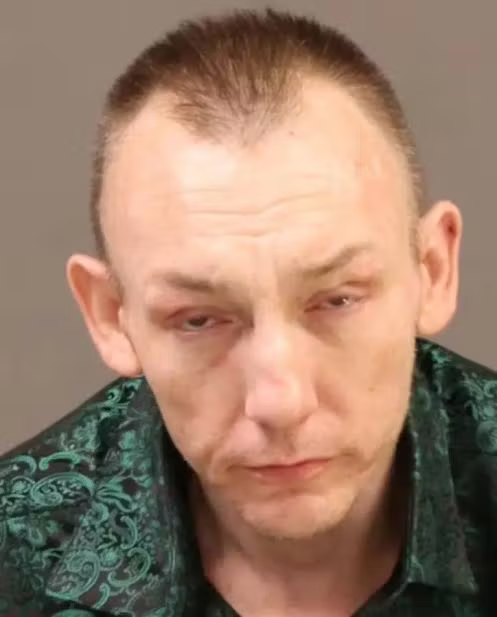
The search made the situation even stranger. According to the criminal complaint, they found a switchblade, two firearms, drug paraphernalia, and forged documents identifying Eugene as a DEA agent.
Eugene was arrested, and the investigation led police to 417 West Chew Avenue, a home in the Olney neighborhood where his father, photographer and filmmaker Raymond “R.C.” Horsch, who died in 2025, had also lived.
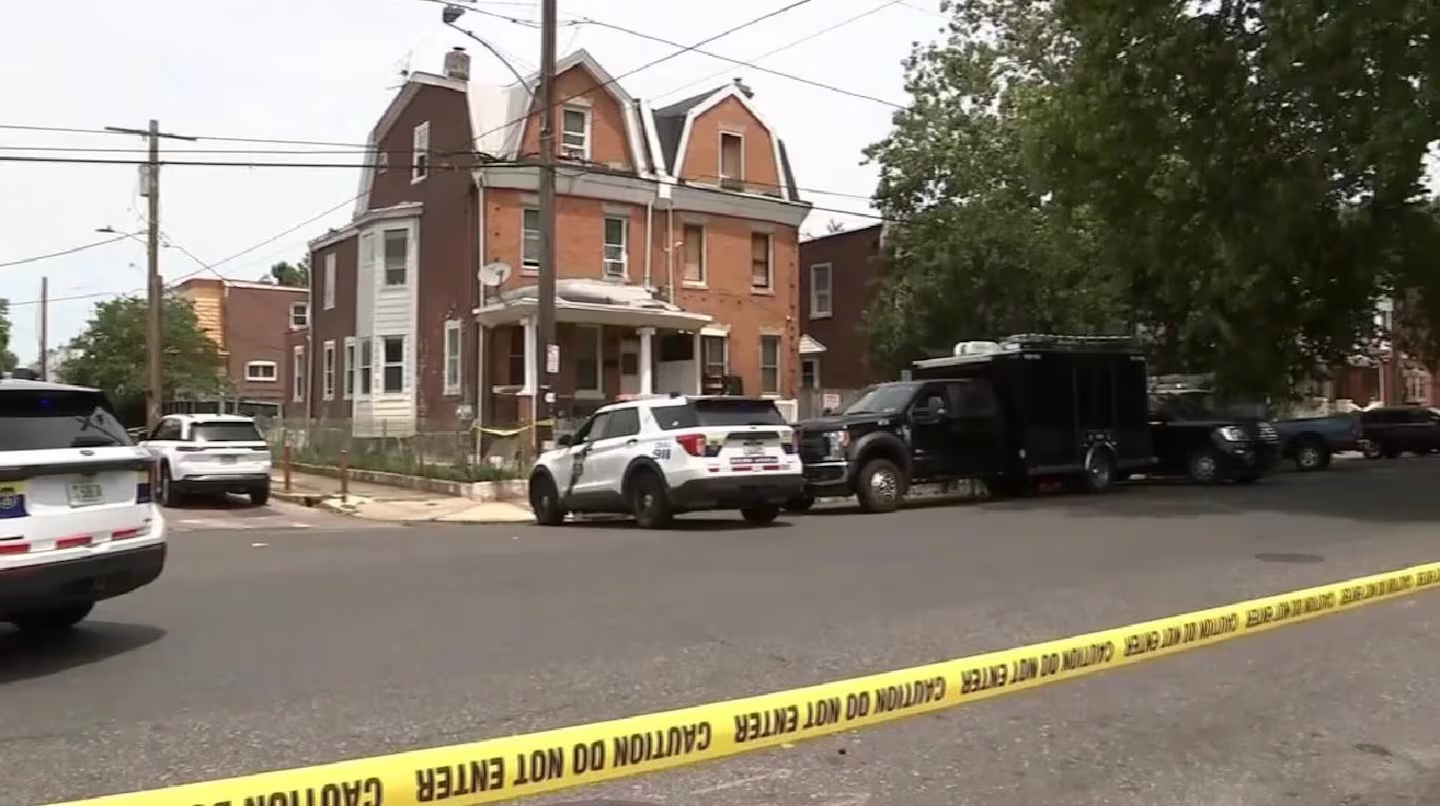
What they found inside turned a chance arrest into something much bigger.
There were hidden spaces with hazardous chemicals, a small marijuana grow, a 208-liter drum connected to hoses and pipes, and around 120 items considered ballistic evidence.
But that was only the beginning.
Investigators recovered more than a million images and videos. By September, they had managed to review only around 30% and identify 58 people.
And many were women.
Of the 58 identified, 16 had been found alive, but were not cooperating with the investigation, and another 25 were also alive and had yet to be interviewed. However, five women appeared in photos or videos with apparent injuries, and at least one appeared to be dead.
Police also found five urns that apparently contained cremated remains. They believe they have identified the origin of three—R.C. Horsch, his sister, and a friend—but up to that point had not confirmed the presence of human remains belonging to possible homicide victims on the property.
Investigators then began cross-referencing those images with cases of women who had been missing for years.
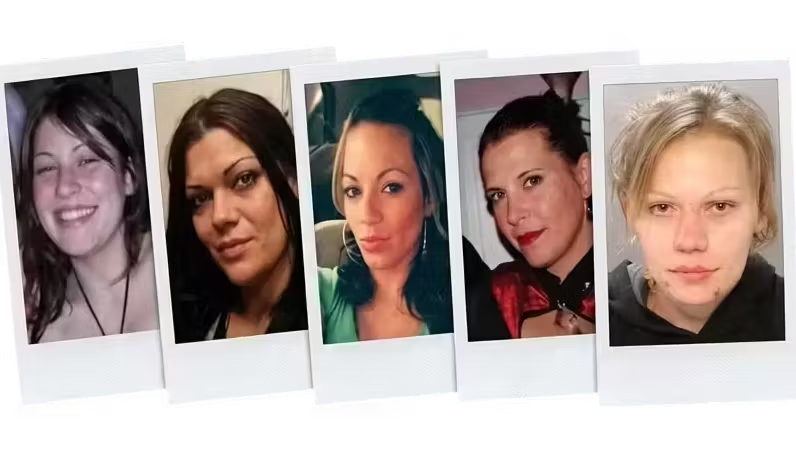
At least seven missing women could have some connection to the house. Five names have already been made public: Gabrielle Amarando, Maribel Fresses, Nicole Fusaro, Amy McHale, and Blair Tonzelli.
Gabrielle was 27 when she disappeared in 2012. Years after no one knew what had happened to her, investigators found her in images taken on the property in 2017. Maribel Fresses, who disappeared at 26, also appears in records from that same year.
But the case of Amy McHale makes the story even more unsettling.
Amy had been married to R.C. Horsch. They divorced but remained friends. On the night she disappeared in 2016, after arguing with her mother, she left her daughter a voicemail saying that she was at Horsch’s house.
She never came back.
And among the million files is another recording that forced investigators to ask themselves a much more disturbing question.
A 2017 video shows R.C. Horsch naked beside a naked woman. As police publicly described it, he handcuffs her to a bed and later places a plastic zip tie around her neck. The woman loses consciousness and ends up apparently motionless.
“She appeared to be lifeless at that point, but that is only an impression”, Deputy Commissioner Frank Vanore warned.
Police still need to determine what really happened. There is no recovered body that would allow them to confirm that the woman in the video died.
And that is precisely the enormous problem investigators face.
R.C. Horsch was a photographer and filmmaker, and for years he produced material in which women acted out scenes of violence, eroticism, and death. His own website described works in which they imagined and acted out their own deaths. Some former models have said that they took part in those productions voluntarily and never felt threatened by him.
For the justice system, an apparently brutal video does not necessarily prove a murder. Physical evidence is needed, such as a body, fingerprints, or the murder weapon; however, they also cannot assume that all of the scenes were performances.
Some women who appear in those files have been missing for years. Investigators believe at least five of the seven linked to the case are probably dead, and the medical examiner has said that some images appear to show dead people if the files are authentic and have not been manipulated.
In addition, a former model, Cassandra Barone, recalled something that is now hard to ignore: the strange smell in the house and Horsch’s warning not to go down to the basement.
Police now have to review the hundreds of thousands of remaining files to determine where fiction ends and where a real crime might begin.
R.C. Horsch will not be able to answer that question. He died in 2025 without ever being charged in connection with these disappearances. His son Eugene remains in custody on charges stemming from the discovery of weapons, drugs, and false documents; police have also said that the compromising videos reviewed so far show his father, not him.
More than a million images were left behind. Some show performances. Others show women who later disappeared. And in some, investigators still do not know whether they are seeing a staged death or a real one.
That last point is the real ending, for me. Much better than “The archive keeps images. The families are still waiting for answers”, which is nice but generic. Here is a detail almost no other case has: the police literally have to investigate whether the deaths they are seeing really happened.
And I would definitely include the initial arrest. The fact that all this horror begins because a park ranger finds a guy illegally parked and the woman with him is carrying the ID of another woman who disappeared three years earlier is too absurd and unsettling to sum up as “the arrest led investigators to the house”.