
In 2011, the beginning of one of the most brutal attacks in television history was recorded live.
American CBS correspondent Lara Logan had spent years building a reputation as a reporter willing to cover conflicts and wars that few journalists dared to face. She had reported from Iraq, Afghanistan, and other scenes of violence.
But that night in Cairo would be a nightmare on Earth.
Egypt was celebrating the fall of Hosni Mubarak. After nearly 30 years in power, the president had resigned, and thousands of people filled Tahrir Square on the night of February 11, 2011, to celebrate.
Among them was Lara, covering the historic day with her team for 60 Minutes.
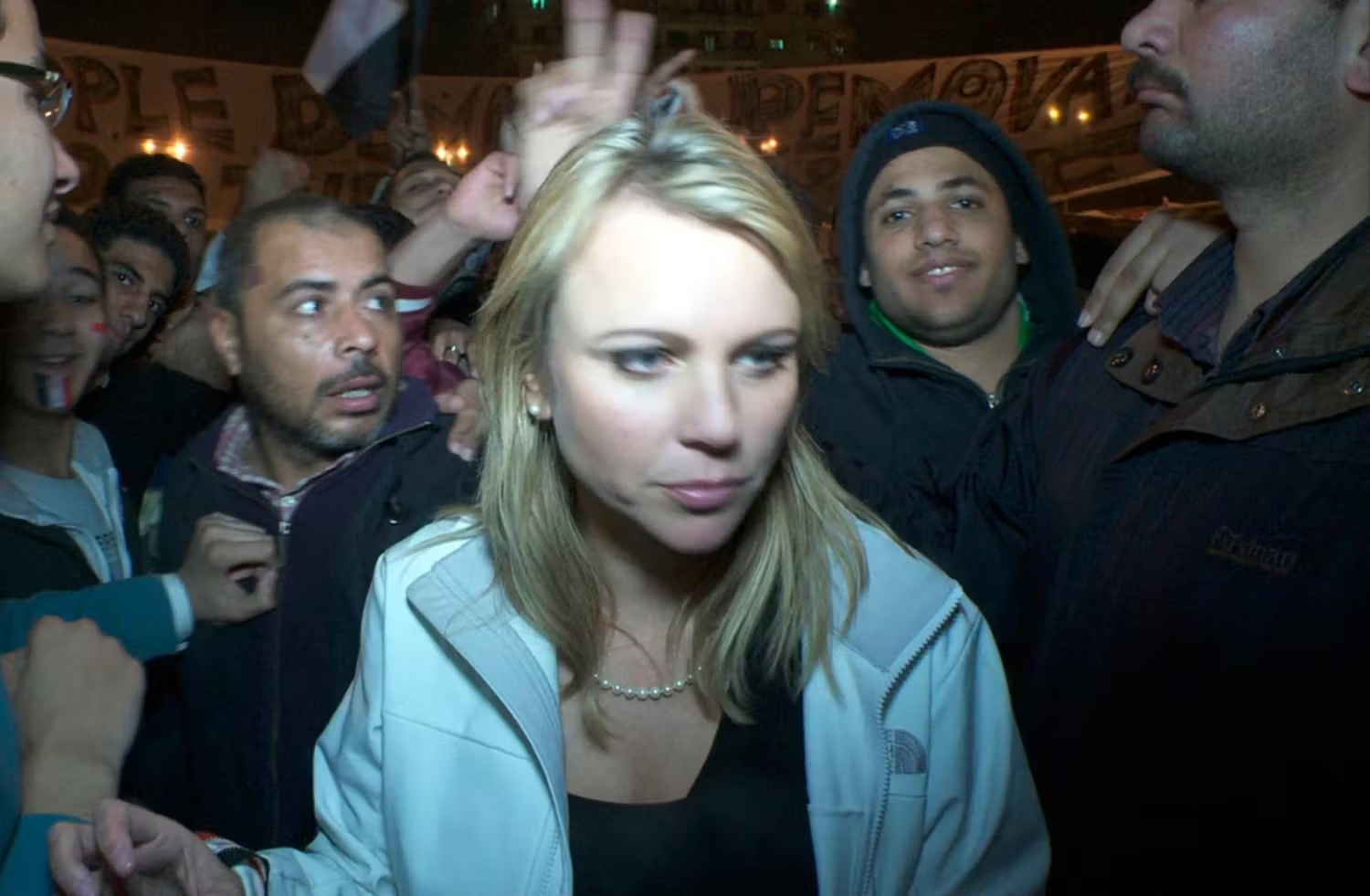
Amid the euphoria, the crowd became increasingly difficult to control. When the camera battery ran out, the team had to stop for a moment. That was when Bahaa, the guide accompanying them who understood what some of the men around them were shouting, looked at Lara and warned her that they had to get out of there.
“Afterward, they told me they were saying: ‘Take her pants off’”.
But it was already too late.
A mob of between 200 and 300 men surrounded the team. Her colleagues tried to keep her protected in the middle of the crowd until Lara was separated from them and disappeared among hundreds of people.
The camera managed to capture some of those final seconds. Then an assault began that would last approximately 25 minutes.
What followed seems almost unreal to describe. Logan later said that she thought she was going to die there.
Logan later recounted that, before fully understanding what was happening, she began to feel hands all over her body. They tore her clothes apart, even breaking the metal clasps of her bra.
I didn’t even know they were hitting me with flagpoles, sticks, and things like that, because I couldn’t feel it, because the only thing I could think about was the sexual assault; it was their hands hurting me again and again and again.
Lara was left at the “mercy” of those men, who did not see her as a woman or as a person, but as a piece of flesh they could take advantage of.
Lara was dragged across the entire square until they reached a fence that stopped the crowd’s advance. On the other side, there was a group of Egyptian women who were camping and, upon seeing the horror, quickly ran toward her.
Lara said she practically fell next to a woman dressed entirely in black, whose eyes she remembers in particular. That woman immediately hugged her.
The other women closed ranks around Lara to protect her while some of her attackers were still trying to reach her. The journalist could barely breathe, and some began pouring water over her while they stayed beside her.
But they still had to get her out of there.
A group of Egyptian soldiers managed to make their way through the crowd, using batons to keep the men away. Finally, they reached Lara, got her out, and reunited her with her team.
They took her back to the hotel, where a doctor examined her. The next day, she returned to the United States and remained hospitalized for four days.
She was safe; however, the trauma had already taken root deep within her.
On May 1, 2011, less than three months after the attack, Lara broke her silence on broadcast television, where she spoke with complete frankness about what had happened.
It was painful to hear, but she had a reason: she wanted her experience to help other victims of abuse and sexual violence and, especially, other female journalists who had experienced similar situations while covering stories and felt that speaking about them could harm their careers.
Lara knew that what happened to her that night was not an isolated case. Many women were injured and for that reason she decided to break the silence and tell a story that many other women were still afraid to tell.
The same journalist who had spent years voluntarily entering wars and conflict zones discovered that night that one of the most dangerous moments of her career would not occur in the middle of a bombing, but surrounded by what many still have the audacity to call people who “were celebrating”.